
- Home
- Office of the President
- State of the University Address
Office of the President

State of the University Address Full Speech
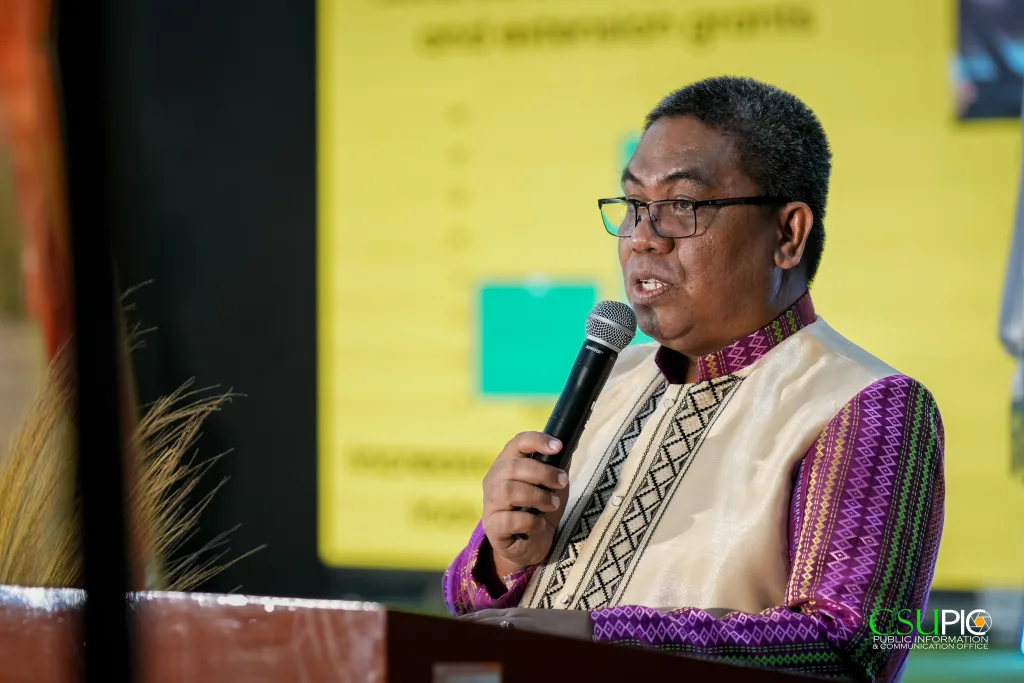
Honorable Chair and Members of the Board of Regents, partners in national government agencies, university officials, alumni and benefactors, faculty and staff, dear students, friends from the community, maayong gabii/magandang gabi/good evening.
Tonight is not a victory lap; It is a calm harbor in the middle of our voyage. We pause to check our compass, refill our courage like fresh water, and then set sail together.
When I first asked for your trust in 2022, I was reminded to “make our own pasture greener rather than look for greener pasture.” That line has guided many choices since then. Progress is something we grow, not something we wait for. My goal this evening is plain – to tell you what we promised, what we did, where we must improve, and what we will finish in the next 18 months, told in clear words, with a few stories, and with deep gratitude.
Compass and Commitment
With that purpose set, let me return to the compass that has guided our choices since 2022. In October 2022, I presented the LIKHA Agenda as our strategic compass anchored on CSU’s talents, assets, and opportunities. LIKHA means five things: Launchpad of global talents and innovators; Interdependence and high-impact coalitions; Knowledge co-creation and commercialization; Hub for academic excellence, innovation, and entrepreneurship; and Accelerated administrative systems and digital transformation. It is not a paper framework; it is our strategy map, the lens for decisions, and the scorecard for results. Guided by LIKHA, we committed to lift our global competitiveness and to execute with discipline. We pledged to modernize University work through an integrated model for decision-making and resource alignment, and to become a borderless university that brings our capabilities to communities. Tonight, we will read our progress through that lens. That was the promise. Now, here is what happened.
Upgraded Capacities
First, how we strengthened our people and learning environment. We strengthened teaching and learning by hiring 153 new plantilla faculty at Instructor I, bringing MS/PhD-qualified faculty to 70%. 148 faculty were reclassified under JC 3, s. 2022, aligning rank with contribution and strengthening morale. We also sent 31 faculty-scholars to pursue their PhDs, our next wave of research leaders and mentors. We set up 8 smart classrooms, giving teachers tools that work and students’ rooms that help them learn. Our programs did the hard work of quality assurance: 97% of undergraduate programs and 85% of graduate programs are now AACCUP-accredited (including 4 Level IV, 11 Level III, 17 Level II, and 1 Level I programs).
In 2025, CHED also approved two new programs, BS Marine Biology, and the Doctor of Information Technology, expanding student pathways in priority disciplines and strengthening our talent pipeline. We debuted in the Times Higher Education Impact Rankings, Top 601–800 globally and Top 3 in the Philippines. We established a Molecular Biology Laboratory and procured equipment for the School of Medicine laboratories. Through DOST-FPRDI, we opened the Regional Forest Products Innovation and Training Center. We then widened our doors to the world by expanding to 51 global partnerships across Asia, Europe, and North America. We began an AI-in-teaching partnership with a South Korean university, bringing new tools and global practice into our classrooms. The result is stronger teaching and mentoring, better spaces for learning, higher external marks of quality, and more pathways for students and faculty to grow.
Partnerships that Solve Real Problems
Stronger people succeed faster when they work with strong partners; here is how we solved problems together. Since 2022, we forged 38 MoUs and 13 MoAs with foreign universities and institutions, onboarded 4 foreign adjunct faculty, and executed 304 collaboration initiatives with LGUs, national agencies, NGOs, industry, and alumni. With alumni at the helm, we rolled out brick-laying builds that improved campus walkways and launched a bike-sharing project to make short trips safer, greener, and easier for students and staff. Together with our Student Affairs and Auxiliary Services, we added 43 study desks along shaded walkways and will install 100 more this year. The NSTP also deployed 30 round tables and two waiting tables, turning corridors into pop-up study lanes and extra workspaces between classes.
In extension, we forged an MOU with the Butuan Chamber of Commerce and Industry (BCCCIFI) to accelerate industry engagement and tech adoption. Active partners grew from 12 (2023) to 26 (2024) to 36 (2025) – a 3x expansion from baseline – while we implemented 60 programs and projects in total over three years (12 in 2023, 15 in 2024, 33 in 2025). This shows steady capacity-building followed by broad roll-out in 2025. Across these partnerships, we trained 2,674 (2023), 4,613 (2024), and 2,963.25 (2025) participants, cumulatively, that’s 10,251 trainees in 3 years. We were recognized as Best Program Partner – NGA/NGO by DSWD-Caraga for PAGLAHUTAY in 2024 and received a Plaque of Appreciation from DepEd-Caraga in 2025 for sustained collaboration. We also positioned our incubators within regional alliances. Navigatu TBI joined the Caraga RISE consortium, so shared resources directly accelerate local solutions. These coalitions helped protect the health of our environment and our communities and supported projects for university resources, infrastructure, and land development through congressional and external partners. The effect is a bigger impact with smarter spending, more expertise in our classrooms and labs, and solutions shaped together with stakeholders.
Ideas Turned to Value
Those partnerships fueled discovery. Now, see how ideas turned into value. Research, innovation, and extension grants totaled Php 307M across 2023-2025-to-date – Php 105M in 2023, Php 118M in 2024, and Php 84M so far in 2025 – a +12% increase in 2024 from baseline and a steady cumulative climb to date. We also launched the LIKHA (SciTech4Dev) Summit 2023, our first large-scale IP and innovation summit aligning research with community needs, which sparked a surge of young researchers submitting proposals and prototypes.
On publications, we moved from a baseline of 105 Scopus-indexed outputs (2023) to 181 (2024), 286 cumulative by end of 2024. In 2025, we submitted 442 papers, with 140 accepted and 130 published in the first half. 97 of them were already Scopus-indexed. We had a cumulative number of 383 by mid-2025 and are on pace for ~486 cumulative by year-end if current trajectories hold.
Impact is not abstract. Industry adopted 18 projects (2023) + 16 (2024) + 9 (1st half 2025), 43 adoptions to mid-2025, with 2025 tracking toward parity with 2024 if second-half uptake sustains.
We also widened our research network. Research partnerships expanded from a baseline of 21 (16 local + 5 international) in 2023 to 58 (29+29) in 2024 and 56 (42+14) in 2025, for a three-year total of 135 partnerships. Local ties grew 2.6 times vs. baseline (42 vs. 16), while international links peaked in 2024 and normalized in 2025, leaving a strong cumulative base (48 international).
In 2025, CSU entered the Scimago Institutions Rankings among 15 Philippine institutions, with our Scopus outputs averaging in Q3 journals. We strengthened capacity by establishing three new RDI centers for the School of Medicine and Cabadbaran Campus in 2025. And to secure momentum, DBM increased our Research Program Budget from Php 2.825M to Php 5.875M (for 2025), approved Php 59.548M (for 2026), plus Php 8M to support the Food & Innovation Center (2026).
Commercialization and venture-building matured. We recorded Php 6.7M in investments and grants for IP commercialization (2023–2025), supported 11 startup or spin-off launches or incubations (lifetime 40), and expanded TBI capacity through Tara Agri-Aqua TBI. Concrete wins include MapX software commercialization through MOAs with LGU Mainit and LGU Oroquieta, totaling Php 1.2M. Within our Php 6.7M commercialization and investment pipeline, IP-linked revenue reached Php1.27M vs a Php 0.5M target, alongside new protections – 4 patent grants, 2 utility models, 4 copyrights, and 1 trademark. Recent grants include the Device for Extracting Sago Starch (patent) and Chocolate-based Confections (utility models).
IP protection and valorization were consistently recognized with IPOPHL’s National Platinum Awards in 2023 (3rd), 2024 (4th), and 2025 (5th), plus our 1st National Palladium Award in 2025. Our ITSO team earned Platinum status and was cited by DOST-PCAARRD as Top IP Filer (Jan 2024), reflecting a stronger pipeline from protection to transfer.
We hosted regional IP masterclasses, IP valuation workshops, and TechReady IP trainings to build inventor and TTLO capability across Caraga, and we hosted a Mindanao-wide Freedom-to-Operate (FTO) Training in July 2025 to de-risk commercialization for regional innovators.
We are now in active commercialization with 13 potential startup products in incubation, e.g., Karlang Nuggets, Pako Chicharon, Crab Rise, HALIKA Fish Device, and Herb-Fruit Blend – advancing from lab bench to market tests. Our innovation teams took 1st Place (National) at DOST-PCAARRD Agri-Aqua Innovation Pitch Fest 2024. These sit alongside the Caraga Food Innovation Consortium, ensuring a steady bridge from lab to market. These gains mean our science is visible and cited, and our research reaches people as products, services, and jobs.
Cabadbaran Campus and its Prowess
At CSUCC, momentum is tangible. In 2025 (Q1–Q3), we secured ₱7.06M in research and extension grants (₱5.13M DA-ACPC; ₱1.53M DBM; ₱0.30M DTI; ₱0.10M LGU Alegria). Our faculty produced 32 Scopus/Web of Science publications (after 15 in 2024), and innovators filed eight IP applications (3 patents, 3 trademarks, 2 industrial designs), including a granted trademark for Green Sweet Delight.
CSUCC teams earned national and regional recognition: Industry Technology Awardee at the 2025 Technology Transfer Conference, 3rd Place at the Innovate to Impact 24-Hour Hackathon, Top 10 finishes in the DOST-PCAARRD Agri-Aqua Innovation Challenge and UPLB Innovation Olympics, and a 1st Place win at RSTW 2025. Students and mentors further sharpened skills through summer schools, pre-accelerators, and hackathons.
Building on a 2024 utility model for Herb Fruit Blend and multiple patent applications since 2023, CSUCC’s pipeline is maturing from lab to market. On the ground, extension stayed active with five programs in 2025 – STEP for HUCAD, BUSWAK, UNITY, BINHI, and SALIKSIK – bringing science and solutions to communities.
Student Success and Reputation
And these investments ripple to our learners and our reputation. We are the top university in Butuan City (EduRank), top in the Philippines for THE Impact Ranking SDG 1, and we improved in Webometrics from 48th to 42nd. Five programs were recognized as PRC Top Performing Schools, and 85% of PRC-monitored programs posted pass rates at or above national levels. Our students earned 56 championships and top rankings in pitching, hackathons, mathematics, digital arts, and speech. Faculty credentials stand at 18% PhD and 53% MS (70% MS/PhD overall), and 83% of first-time takers sat for the boards within a year.
Our innovation culture also translated into student-founder recognition: STELLA.ai placed 3rd at the Philippine Startup Challenge 9 (2024), NaviPort took 1st Place at the Caraga Pitching Fest (2025), and BlackGold Nutribar won 3rd Place at the National Young Farmers Challenge (2025) with a ₱500,000 grant, clear signals that CSU talent competes and wins on national stages. CSU TBI teams advanced to Top 20 and Top 10 at Pagsanyog 2025, strengthening our founder pipeline.
Faster Service, Better Stewardship
Behind these outcomes is everyday stewardship that keeps the university running better and faster. We enhanced 30 online system modules, rolled out 49 new modules, and moved 9 major systems toward full automation. We launched BALINTATAW, our information system for quality assurance and performance monitoring. We secured CSC PRIME-HRM re-accreditation for Performance Monitoring and for Recruitment and Selection. We remained eligible for the Performance-Based Bonus for 9 straight years and ranked among DBM’s Top 3 FY 2024 fiscal performing agencies in Mindanao. We built and repaired spaces: a school canteen in Cabadbaran and six-classroom buildings on both campuses, plus major repairs at the College of Education, Batok Hall, and Hiraya Hall.
We partnered with SEEMESOL to run a digital recruitment system that improves graduate employability. We refreshed our audio-visual facilities with a high-fidelity sound system, an LED wall, and new air-conditioning. We installed a campus paging and alarm system; and we put in place a vehicle tracking system.
The outcome is fewer lines, clearer records, quicker transactions, safer and better-equipped campuses, and stronger public trust.
Stories Behind the Numbers
Numbers matter, but faces tell the story – allow me to share a few. Our pioneers in medicine are now here at CSU because the Doctor of Medicine curriculum is approved, the first cohort has begun, and the School of Medicine laboratories are equipped. Nine Associate Professors are in place to mentor them. The message is simple: future doctors for Caraga can now train at home.
In another corner of the University, a student–faculty team carried a food innovation from our incubator to the marketplace, supported by our startup program, the 13 innovations and IP produced so far, ₱15M in commercialization revenue, 7 granted patents, and the Caraga Food Innovation Consortium that links R&D to MSMEs.
This is research becoming a livelihood. And our founders kept winning: STELLA.ai took 3rd at PSC9 (2024); NaviPort topped the Caraga Pitching Fest (2025); and BlackGold Nutribar earned 3rd at the National Young Farmers Challenge (2025) with a ₱500,000 grant.
In our classrooms, global learning is now brought home through an AI-in-teaching collaboration with a South Korean university. That effort sits within a wider web of 51 international partnerships. We work with foreign adjunct faculty and ensure mobility for students and faculty. These are not isolated triumphs.
They show that CSUans turn programs into possibilities, learning that lifts careers, research that becomes enterprise, and partnerships that serve our people.
What We Must Finish
We celebrate these gains, and we do not sugarcoat unfinished work. We have 9 major systems in various stages of automation. We need to complete them and integrate them so that data flows well across students, human resources, finance, quality assurance, and procurement, exactly the integrated model we committed to build for faster, evidence-based decisions.
We must keep improving our spaces by continuing repairs and builds, and by upgrading laboratory facilities and equipment where it will help the most. We must sustain our accreditation and ranking gains and deepen them across programs and campuses. And we must scale our partnerships and mobility so that more students and more faculty benefit every term, living up to the spirit of a borderless university serving communities where they are.
The Next 18 Months
Here is how we will close these gaps in the next 18 months.
Our commitments for the next 18 months follow these needs. We will integrate our digital backbone, bringing student, HR, finance, QA, and procurement data into a seamless flow drawn from the systems we have already enhanced, rolled out, and put in motion. We will strengthen people and performance by supporting our newly hired and reclassified faculty with training and by aligning rewards with service gains and student outcomes. We will grow global learning by activating more co-teaching, research tie-ups, and short-term mobility under our 51 partnerships and foreign adjunct arrangements, including the AI-in-teaching link. We will push research to impact by building on the annual funding we have secured, the patents we have earned, the commercialization results we have posted, and the steady pipeline created by the Food Innovation Consortium. We will keep modernizing spaces through by-admin construction and major repairs, continuing upgrades to audio-visual, safety, and tracking systems, and equipping laboratories that drive our priority programs, including the School of Medicine. Lastly, we will keep public trust high by maintaining our PRIME-HRM standing and PBB eligibility, by keeping our fiscal performance strong, and by using BALINTATAW to monitor what works and where to improve.
Guided by the Global Recognition and Quality Excellence Roadmap, we will: (1) 2024 – strengthen capability for AUN-QA and pursue international accreditation tracks (PTC/PICAB/Seoul Accord); (2) 2025 – complete submissions and compliance for QS and THE rankings and file our ISO 21001:2018 application while preparing AUN-QA self-assessments; (3) 2026 – integrate QA by seeking AUN-QA institutional assessment, having three programs assessed, and targeting PQA Level 4, ISO 21001:2018 certification, and UNEVOC membership; (4) 2027 – expand to six AUN-QA–assessed programs; and (5) 2028 – advance national institutional leveling (SUC Level V overall, Level IV for the Main Campus, Level II for CSUCC). All of this is anchored in internationalization and stronger research-and-innovation productivity under LIKHA.
And so, we end where we began: with clarity of purpose and a shared call to action. Friends, the story of our first half is clear. We kept our promises, we learned from our detours, and we built momentum across people, programs, partnerships, and platforms.
The second half asks more of us. Let us carry forward the spirit of 2022 – WE can. WE will. TOGETHER, it is possible. Let us keep LIKHA as our compass – creating new value, meaningful solutions, and responsible stewards and leaders.
I did not promise calm waters. I promised movement toward our shared direction and joy in paddling. Hiraya manawari sa sabay-sabay nating pag-LIKHA. Daghang salamat and onward, Golden Paddlers!