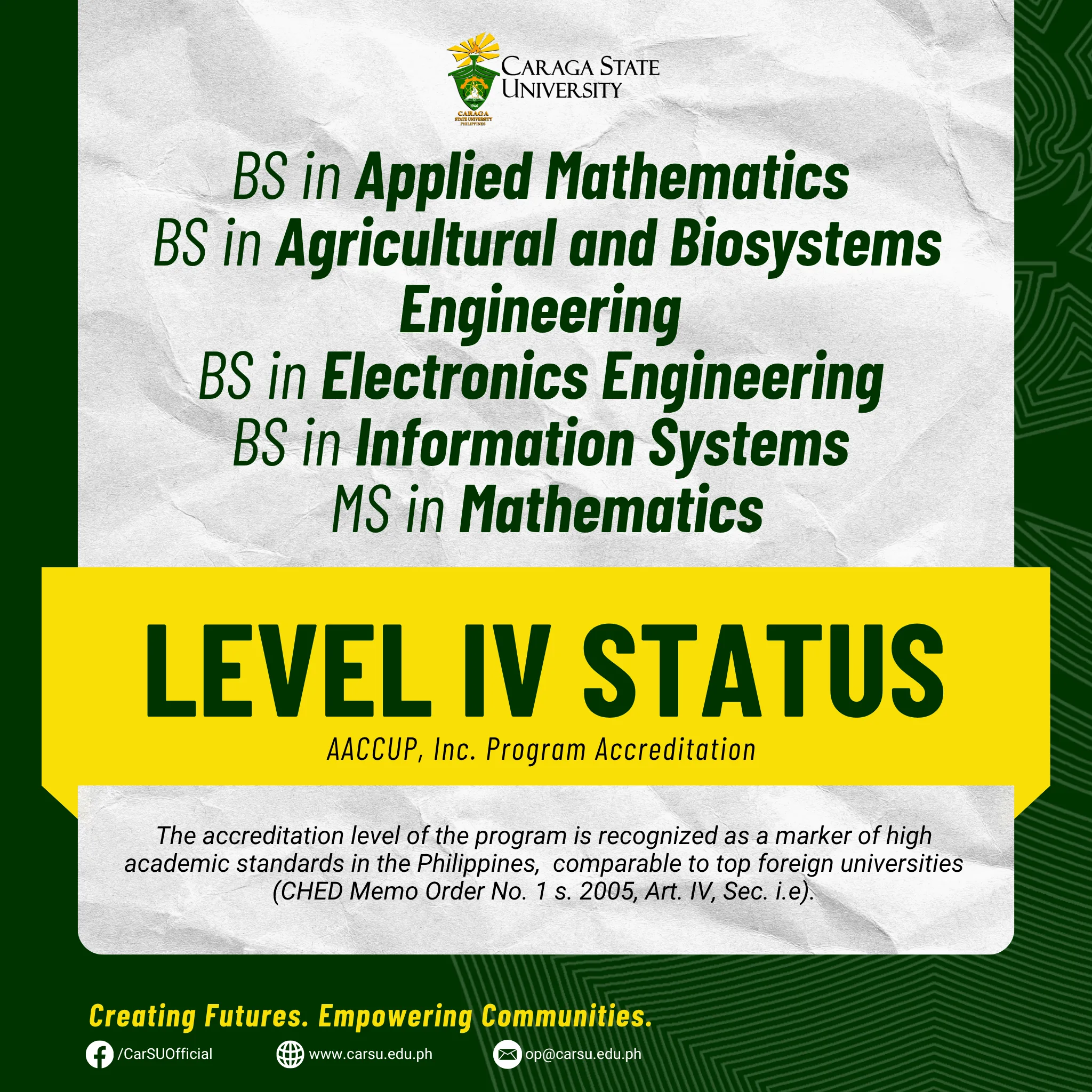
Five more programs earn Level IV Accreditation from AACCUP, Inc.
Caraga State University (CSU) adds another belt to its achievements following the recently released Board...
“Your BEST Option to SUCCESS”
The College of Computing and Information Sciences (CCIS) is steadfast in its commitment to advancing regional and national development through its core mandates of instruction, research, production, and extension. As a premier academic unit in the field of computing and information technology, the college is devoted to cultivating excellence in education and fostering innovation that responds to the dynamic needs of industry and society.
Research
Instruction
Production
Extension
Research
Instruction
Production
Extension
| The Bachelor of Science in Computer Science provides students with a strong foundation in computing concepts, algorithms, programming, and software engineering, balancing theoretical and practical aspects of the field. Its curriculum includes core areas such as computer architecture, data structures, databases, operating systems, networks, artificial intelligence, and theory of computation. Guided by CMO No. 25, s. 2015, the program integrates general education courses, common computing core subjects, professional and elective courses, and domain-specific topics. Students are also required to complete practicum work and a thesis project. Overall, the BSCS program develops analytical, mathematical, and research skills essential for innovation and real-world problem-solving in computing. |
Program Educational Objectives (PEOs) for Bachelor of Science in Computer Science
In three to five years, the graduates of the Bachelor of Science in Computer Science are expected to:
PEO 1 | Demonstrate problem-solving and critical thinking skills, capable of analyzing complex computing challenges, designing innovative solutions, and applying their expertise to address real-world problems in local and global contexts.
Keywords: problem-solving, critical thinking skills, analysis, innovative solutions, apply expertise. |
PEO 2 | Engage in research or technological advancements aligned with Sustainable Development Goals (SDG) while demonstrating entrepreneurial acumen through impactful societal and industry engagements.
Keywords: Research, Sustainable development, entrepreneurial acumen |
PEO 3 | Actively pursue lifelong learning, continuously enhancing their technical expertise, innovative capabilities, and ethical practices while leveraging emerging digital technologies. Keywords: lifelong learning, enhancing expertise, innovative, ethical practices |
Program Outcomes (POs) for Bachelor of Science in Computer Science
The students of the Bachelor of Science in Computer Science are expected to:
PO1 | Analyze a complex computing problem and to apply principles of computing and other relevant disciplines to identify solutions; |
PO2 | Design, implement, and evaluate a computing-based solution to meet a given set of computing requirements in the context of the program’ discipline; |
PO3 | Communicate effectively in a variety of professional contexts; |
PO4 | Recognize professional responsibilities and make informed judgments in computing practice based on legal and ethical principles; |
PO5 | Function effectively as a member or leader of a team engaged in activities appropriate to the program’s discipline |
PO6 | Identify and analyze user needs and to take them into account in the selection, creation, integration, evaluation, and administration of computing-based systems. |

| The Bachelor of Science in Information System includes the study of applications and the effects of information technology on organizations. Graduates of the program should be able to implement an information system that considers complex technological and organizational factors affecting it. These include components, tools, techniques, strategies, methodologies, and the like. Graduates are able to help an organization determine how information and technology-enabled business processes can be used as a strategic tool to achieve a competitive advantage. As a result, IS professionals require a sound understanding of organizational principles and practices so that they can serve as an effective bridge between the technical and management/users’ communities within an organization. This enables them to ensure that the organization has the information and the systems it needs to support its operations. |
Program Educational Objectives (PEOs) for Bachelor of Science in Information Systems
In three to five years, the graduates of the Bachelor of Science in Information Systems are expected to:
PEO 1 | Initiate solutions to technical and organizational challenges using critical thinking, programming, and ICT skills, while leveraging emerging technologies to optimize business processes and management. Keywords: Leadership, Problem solving, Critical Thinking |
PEO 2 | Demonstrate excellence in bridging technical and managerial fields through expertise in research, innovation, and tech-driven business integration to drive organizational advancement. Keywords: Research, Innovation, and Entrepreneurship |
PEO 3 | Immerse in continuous learning and professionalism, conforming to the evolving IT landscape, Information System environment, and interdisciplinary fields while upholding legal and ethical standards. Keywords: Lifelong Learning and Social Responsibility |
Program Outcomes (POs) for Bachelor of Science in Information Systems
The students of the Bachelor of Science in Information Systems are expected to:
PO1 | Analyze a complex computing problem and to apply principles of computing and other relevant disciplines to identify solutions. |
PO2 | Design, implement, and evaluate a computing-based solution to meet a given set of computing requirements in the context of the program’s discipline. |
PO3 | Communicate effectively in a variety of professional contexts. |
PO4 | Recognize professional responsibilities and make informed judgements in computing practice based on legal and ethical principles |
PO5 | Function effectively as a member or leader of a team engaged in activities appropriate to the program’s discipline |
PO6 | An understanding of and an ability to support the use, delivery, and management of information systems within an Information Systems environment. |
| he Bachelor of Science in Information Technology includes the study of the utilization of both hardware and software technologies involving planning, installing, customizing, operating, managing, administering, and maintaining information technology infrastructure that provides computing solutions to address the needs of an organization. The program prepares graduates to address various user needs involving the selection, development, application, integration, and management of computing technologies within an organization. The curriculum also includes fundamentals and applied practice such as core information technologies of human-computer interaction, information management, programming, web systems and technologies, networking, System administration and system maintenance, and System integration and system architecture. |
Program Educational Objectives (PEOs) for Bachelor of Science of Information Technology
In three to five years, the graduates of the Bachelor of Science in Information Technology are expected to:
PEO 1 | Demonstrate competency in analyzing, designing and evaluating information and communication technology (ICT) solutions to real-world problems.
Keywords: competency, analysis, design, evaluate, ICT solutions |
PEO 2 | Contribute innovative ICT-based products and services towards positive transformation within the communities and organizations.
Keywords: Innovation, positive transformation |
PEO 3 | Demonstrate a commitment to lifelong learning by advancing knowledge and skills in emerging technologies, engaging in innovative projects that address societal challenges, and contributing to the IT field in ways that promote ethical practices. Keywords: lifelong learning, engagements, advancing knowledge, ethical practices |
Program Outcomes (POs) for Bachelor of Science of Information Technology
The students of the Bachelor of Science in Information Technology are expected to:
PO1 | Analyze a complex computing problem and to apply principles of computing and other relevant disciplines to identify solutions; |
PO2 | Design, implement, and evaluate a computing-based solution to meet a given set of computing requirements in the context of the program’ discipline; |
PO3 | Communicate effectively in a variety of professional contexts; |
PO4 | Recognize professional responsibilities and make informed judgments in computing practice based on legal and ethical principles; |
PO5 | Function effectively as a member or leader of a team engaged in activities appropriate to the program’s discipline |
PO6 | Identify and analyze user needs and to take them into account in the selection, creation, integration, evaluation, and administration of computing-based systems. |
The Master of Science in Information Technology program designed to develop advanced competencies in IT through a balance of theory, research, and practical application. It prepares professionals to design, implement, and manage innovative IT solutions addressing organizational, societal, and global challenges. Grounded in outcomes-based education, the program fosters critical thinking, ethical leadership, and evidence-based decision-making. Graduates are equipped to take on key roles in industry, academe, and research, contributing to digital transformation, technological innovation, and sustainable development. The MSIT program ensures that students emerge as skilled, forward-thinking IT professionals ready to drive progress in an increasingly technology-driven world.
The Doctor in Information Technology program is the terminal degree in the field, designed to develop visionary leaders and innovators who drive the advancement of ICT solutions to address complex, interdisciplinary challenges at both local and global levels. It prepares scholars to mentor researchers and innovators in creating transformative ICT-based products and services that generate meaningful impact across various sectors. The program fosters thought leadership through scholarly publications, keynote engagements, and international collaborations, promoting the ethical and equitable use of technology. As a terminal degree, it equips graduates with the highest level of expertise and leadership capacity to advance research, innovation, and sustainable technological development.
Caraga State University (CSU) adds another belt to its achievements following the recently released Board...
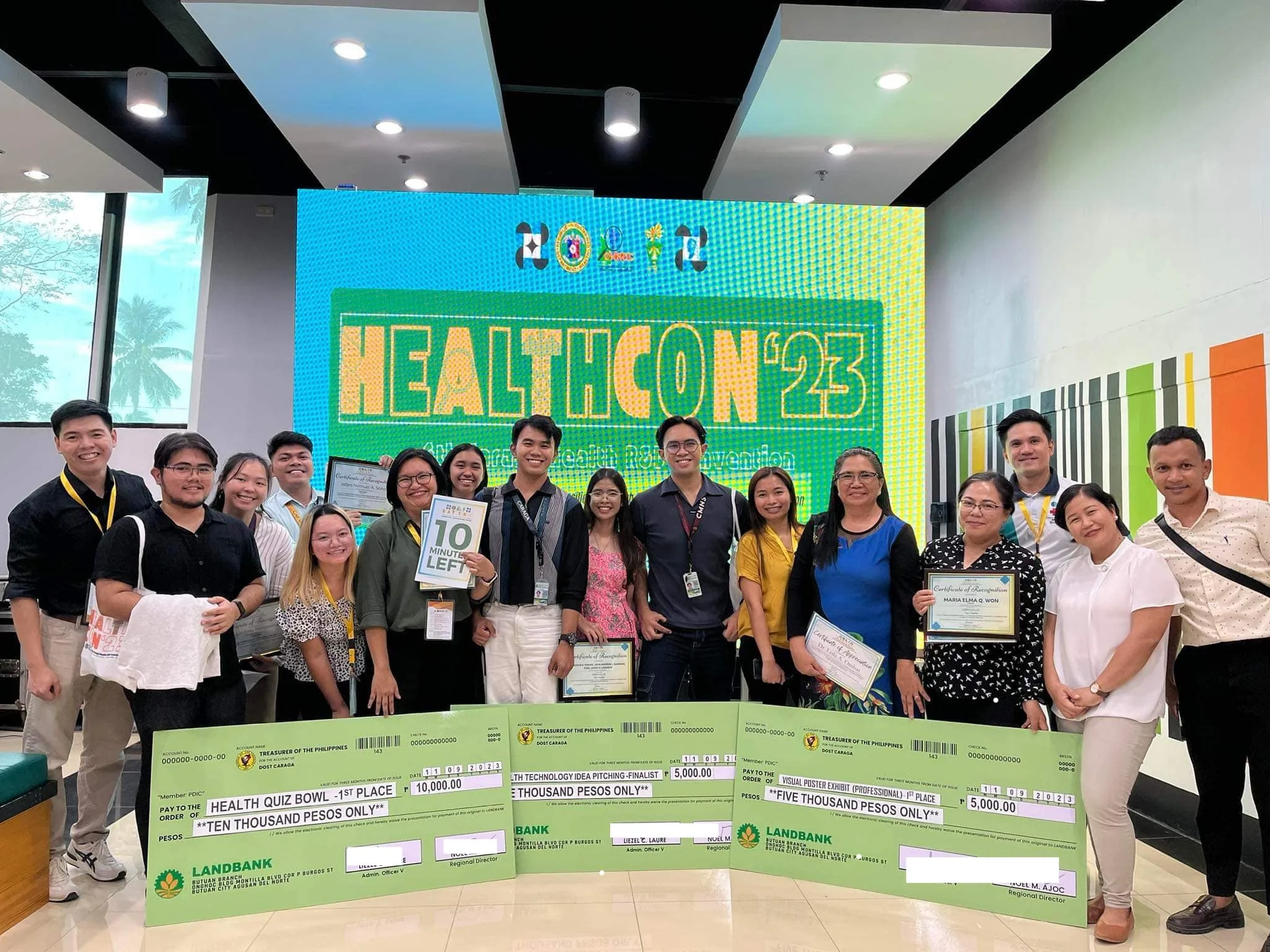
Students from the College of Mathematics and Natural Sciences (CMNS) and the College of Computing...
Find the right program for you. Get personalized recommendations based on your personal interests.
For concerns and Inquiry about the website please visit
Public Information and Communication Office
or email us at pico.csu@carsu.edu.ph